



Contact center efficiency in banking
Contact center efficiency in banking is how quickly, accurately, and compliantly a bank resolves a customer interaction across phone, chat, and digital channels – measured through average handle time (AHT), first contact resolution (FCR), and call deflection rate, and improved without adding headcount or compliance risk.

SETTING THE SCOPE
What efficiency means for a bank's contact center
Also called call center efficiency, the discipline covers the same banks and contact centers whether the interaction happens by phone, chat, or in-app. Financial institutions carry a condition generic contact centers do not: every efficiency gain has to survive a compliance review.
Cutting handle time by skipping an identity check, or deflecting a call without a full audit trail, is not efficiency – it is exposure. Unblu treats contact center efficiency as a byproduct of giving agents better context and assist tools at the point of the interaction, not a target reached by removing steps a regulator would flag.
That discipline shows up in the performance metrics banks track together: average handle time, first contact resolution (also called first call resolution), call deflection rate, agent performance, and service level – commonly the “80/20” rule, the share of calls answered within a set time. Improving one in isolation – rushing calls to cut AHT, for instance – usually damages another; a bank cutting AHT without watching first contact resolution just pushes the same issue into a second call.
This page maps how contact center efficiency works for banks: what it delivers for each part of the buying decision, where the results come from, and the specific capabilities and deeper guides beneath it.
THE JOB TO BE DONE
Cut cost-to-serve without losing the customer or the compliance case
The underlying job is not “reduce AHT.” It is to resolve more conversations, faster, in a way that lifts customer satisfaction and the broader customer experience rather than trading one for the other – without the tradeoffs that show up later as churn or a compliance finding. That job looks different to each member of the buying committee.
Wants measurable AHT reduction and headcount avoided or reallocated. The business case needs to show efficiency gains that translate to cost-to-serve, not just a smoother agent experience.
Wants fewer transfers and higher first-contact resolution, measured weekly, without the customer service experience feeling rushed. Tools have to sit inside the workspace agents already use – anything that adds a screen or a login sees low adoption.
Wants the efficiency layer to connect to the CRM and core banking systems already in place – Salesforce, Avaloq, Backbase – without a custom build.
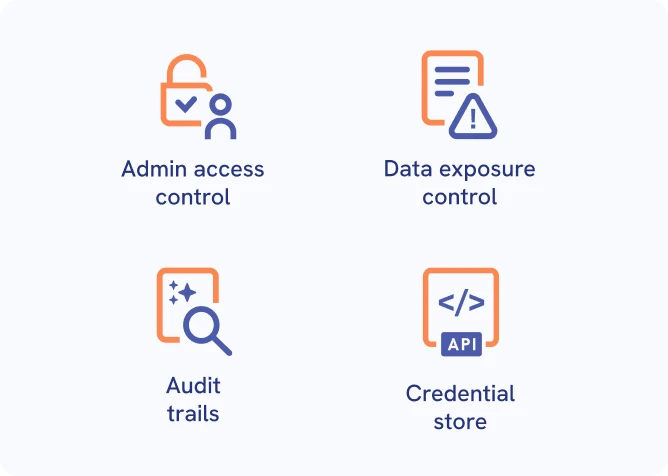
Wants a full audit trail on every AI-assisted interaction, masked sensitive fields during any screen-level assistance, and a human in the loop on regulated steps.
Nothing ships without the audit trail
The compliance and security gatekeeper can veto the entire initiative. An efficiency tool that cuts AHT but can't produce a full record of what an AI suggested, and whether a human accepted it, does not deploy in a regulated bank. More than eight in ten bank employees rate their own contact center's digitalization as low, per Capgemini research – a sign most institutions are still choosing between speed and defensibility, rather than getting both.
HOW UNBLU APPROACHES IT
Efficiency built on the audit trail,
not around it
Unblu closes the cost-to-serve gap without trading away service quality, by putting the assist layer where the interaction happens, rather than adding another system for agents to check.
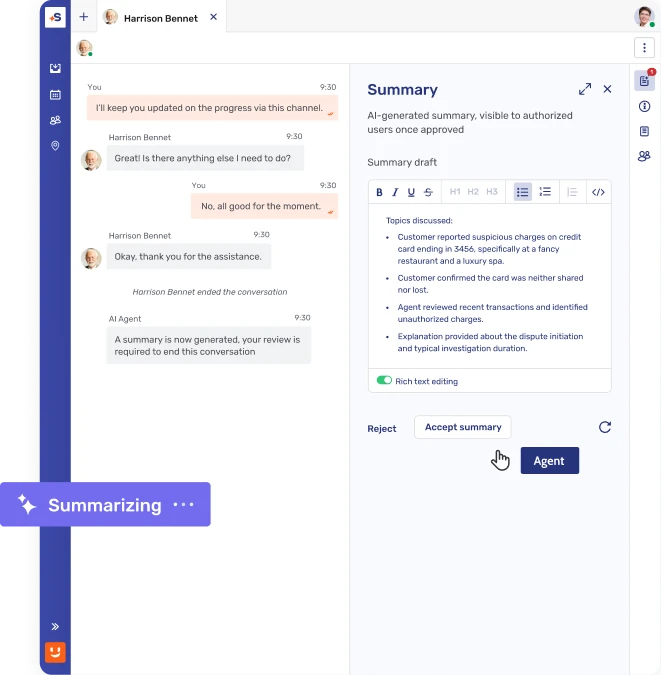
Unblu Aria's Bot Sidekick delivers real-time next-best-action prompts inside the same window an agent is already working in, so questions get answered without a hold or a transfer, while Summaries and Transcripts cut the after-call work that otherwise adds to handle time once the conversation ends.
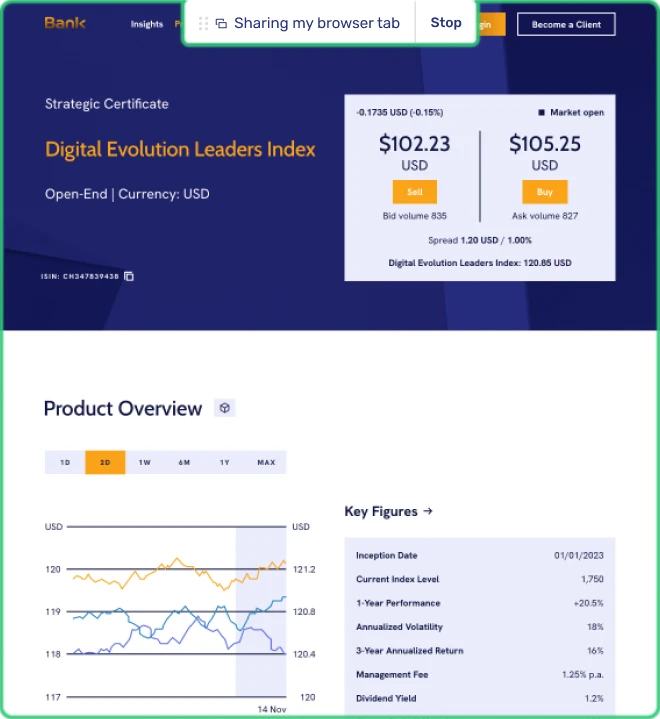
Embedded Co-Browsing lets an agent see and guide a customer through the exact same interface, removing the back-and-forth that inflates handle time on account, form, and troubleshooting calls. Live Chat's concurrent-session handling lets one agent manage several conversations at once, absorbing volume without adding headcount.
Every capability above sits inside Unblu Spark and Aria, so the same audit trail, authentication, and data-masking controls apply whether the interaction started on the phone, in chat, or in-app. PostFinance has run this combination for more than seven years, consolidating its entire inbound team into a single inbox and holding a stable AHT across text and voice channels through media blending.

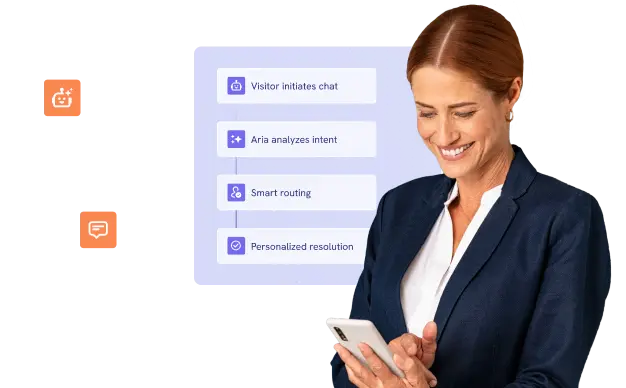
Explore the no-code Flow Builder, intent routing, and compliance architecture in detail.
Explore Unblu Aria
BUSINESS IMPACT
What banks are achieving with contact center efficiency
AHT reduction, from 8 min 20 sec to 6 min 40 sec
increase in agent productivity after adding Live Chat and Co-Browsing
AHT improvement vs. projection, 18 min actual against a 30-min estimate
client satisfaction after a Co-Browsing session
bot-handling rate, up from 55% at launch
rise in support requests absorbed without added headcount
Why this matters beyond any one bank
McKinsey's April 2026 analysis of AI in banking customer care found that properly implemented AI-driven contact center transformations deliver a 10 to 20 percent reduction in average handling time and a 15 to 25 percent improvement in first-call resolution – the same two metrics this page is built around. The gains only materialize, McKinsey notes, when banks redesign the underlying process alongside the technology, not when AI is layered onto an unchanged workflow – the same discipline behind Unblu's audit-trail-first approach above.
CUSTOMER PROOF
Contact center efficiency, verified across two very different pressures
Two examples show what this looks like under real operational strain – one during a client migration, one under sustained volume.

Banca Dello Stato added Live Chat and Co-Browsing across a support team serving roughly 60,000 e-banking customers, moving 20% of requests to Live Chat and holding Co-Browsing-assisted calls to a 10-minute average AHT – the team absorbed a 15% rise in requests without adding headcount.

Crédit Agricole next bank used Embedded Co-Browsing to guide more than 60,000 migrating clients through a new e-banking platform during a period when support call volume multiplied tenfold, containing AHT to 18 minutes against a 30-minute projection, with client satisfaction reaching 4.7 out of 5 after a Co-Browsing session.
SUPPORTING CAPABILITIES
The platform underneath this experience

Live Chat's concurrent-session handling lets one agent manage multiple conversations in real time, embedded directly in the bank's own channels.
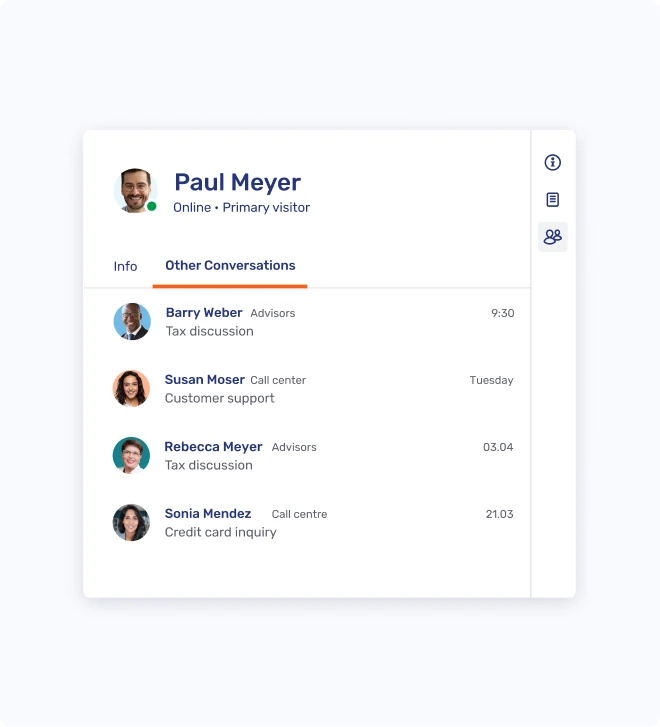
Embedded Co-Browsing and Mobile Co-Apping let an agent see and guide a customer through the same interface, masking sensitive fields automatically, on web or in-app.


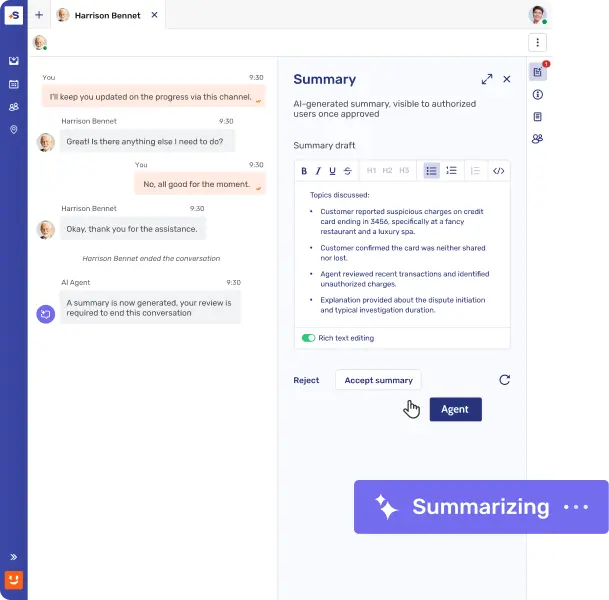
Suggestion Support delivers customer-invisible, real-time next-best-action prompts; Summaries and Transcripts cut after-call work and post-conversation admin, supporting compliance documentation.
RELATED Content
Go deeper:
the contact center efficiency cluster
This hub maps the topic. The linked content below provides the deeper treatment – each focused on one sub-topic in the cluster.
Frequently asked questions
Talk to us about contact center efficiency
See how Aria and Unblu Spark fit your institution's existing systems, compliance requirements, and customer experience goals.
