



Conversational AI in banking
Conversational AI in banking is the use of AI-driven messaging, voice, and workflow automation to handle and assist customer conversations inside a bank's own channels – resolving routine queries automatically, equipping advisors with real-time support, and keeping every interaction compliant and auditable.

SETTING THE SCOPE
What conversational AI means in a regulated banking context
Conversational AI is not a single product. In banking, it performs two distinct roles: automating routine customer service, like an AI virtual agent handling intake, triage, and common questions across the bank's website, mobile app, and messaging channels; and augmenting human advisors with tools that listen, suggest, summarize, and translate in real time, embedded directly into the workspace they already use.
Sometimes called conversational banking, this combination applies across financial services: retail banks handling call volume, wealth managers extending advisor relationships, and insurers processing document-intensive requests. The appeal is consistent: handle more conversations, faster, without adding headcount or compliance risk.
The more recent term for the architecture behind this is agentic AI: systems that don't just respond to queries but take actions, complete multi-step tasks, and escalate to a human with full context when needed. In banking, that agent layer is what bridges automation and compliance. It operates inside the institution's own security and compliance perimeter, not a consumer chat app, keeping model data under the bank's control, enforcing human handoff for regulated steps, and connecting to the systems advisors already use, from core banking and CRM to document management
and e-signature.
This page maps how conversational AI works in banking, what it delivers for each part of the buying decision, and where the results come from. The linked articles provide deeper treatment of each sub-topic.
THE JOB TO BE DONE
Resolve more conversations – without adding headcount or compliance risk
The underlying job is not to simply “deploy a chatbot.” It is to handle more customer conversations, faster, in channels customers already trust. That job looks different to each member of the buying committee.
Wants measurable deflection and productivity: fewer calls escalated, more conversations handled per advisor, shorter Average Handling Time (AHT). The business case needs to show efficiency gains equivalent to headcount saved or revenue from service-to-sale conversion.
Wants tools their team will actually use. AI that suggests the next best answer inside the existing workspace, not another screen to switch to. Speed of adoption matters as much as the feature set – a tool that requires retraining or a new workflow will see low uptake.
Wants the AI layer to connect to core banking, CRM, and the existing authentication system without a custom build. Native connectors for the platforms already in use – Avaloq, Backbase, Salesforce, Temenos – are a hard requirement. Custom integration means delay, risk, and ongoing maintenance.
Where conversation data goes, which model sees it, whether the bank can keep that model in its own environment, and whether every AI-touched interaction is logged for audit. Also: how identity verification (ID&V) and Know Your Customer (KYC) steps are handled when an AI agent is in the loop, and how records are retained for regulatory purposes.
Nothing gets deployed without compliance
The compliance and security gatekeeper is the role that can veto the entire project. A conversational AI feature that improves handling time but cannot satisfy data-governance and retention requirements never deploys in a regulated bank. This is the most under-served need in the market – and the one that separates compliance-first conversational AI from a generic chatbot bolted onto a website.
HOW UNBLU APPROACHES IT
Compliance-first, not chatbot-first
Unblu delivers conversational AI through Unblu Aria, the AI and workflow layer of the Unblu Spark platform. Aria is built around three principles that separate banking conversational AI from generic deployments.
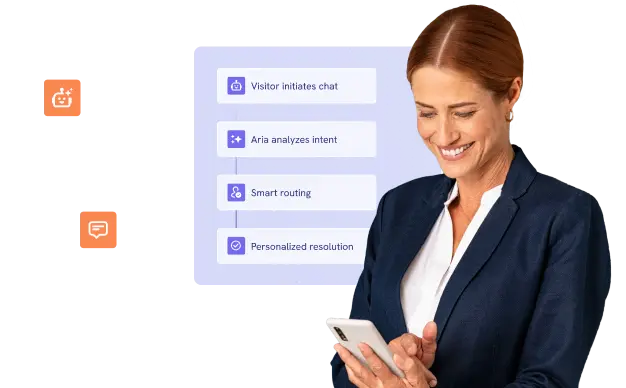
Open-ended queries route to AI via an intent-based bot. Regulated steps follow deterministic, rule-based flows with a human in the loop. The bank decides which is which, designing both in a no-code visual Flow Builder. Teams already invested in Microsoft can design those flows through a native Copilot Studio integration.
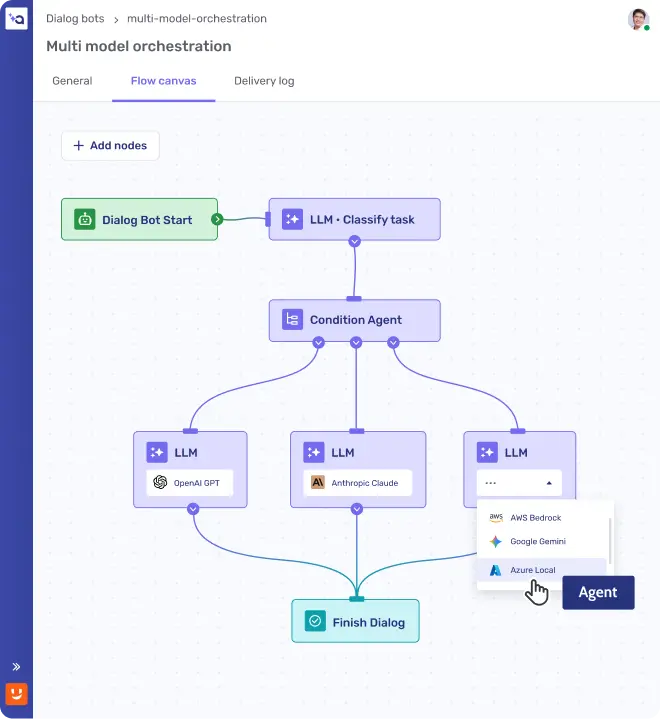
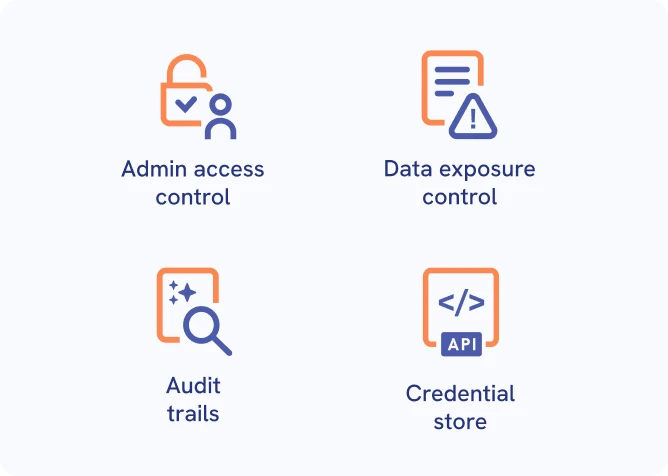
Aria is LLM-provider independent – Azure OpenAI, OpenAI, Anthropic, or a local on-premise model. Banks can connect their own keys and run inference entirely within their own infrastructure. No customer content is used to train models. Every AI interaction is logged in a full audit trail.
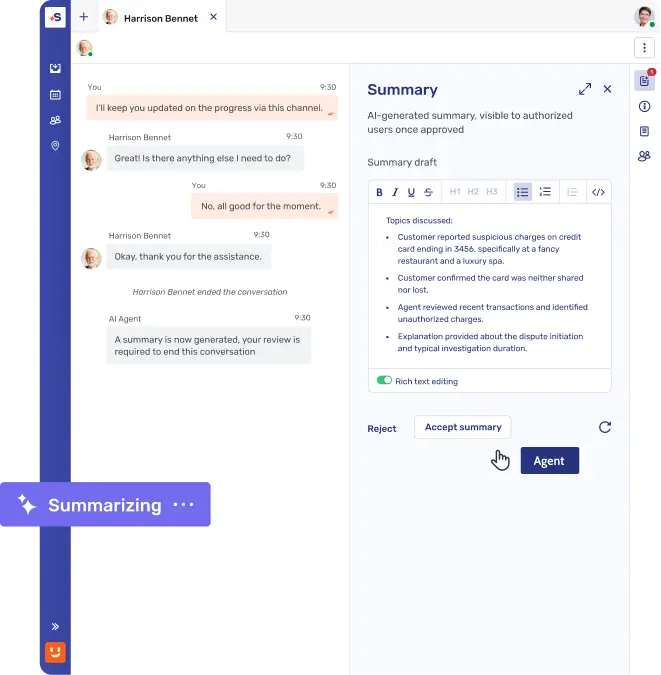
On the customer side, an AI Virtual Agent handles intake, triage, and routine questions, using intent detection to route each conversation to the right flow. On the advisor side, Suggestion Support (Bot Sidekick) delivers real-time, customer-invisible answer suggestions and next-best-action prompts inside the workbench – while summaries, transcripts, and writing support cut post-conversation admin.

Explore the no-code Flow Builder, intent routing, and compliance architecture in detail.
Explore Unblu Aria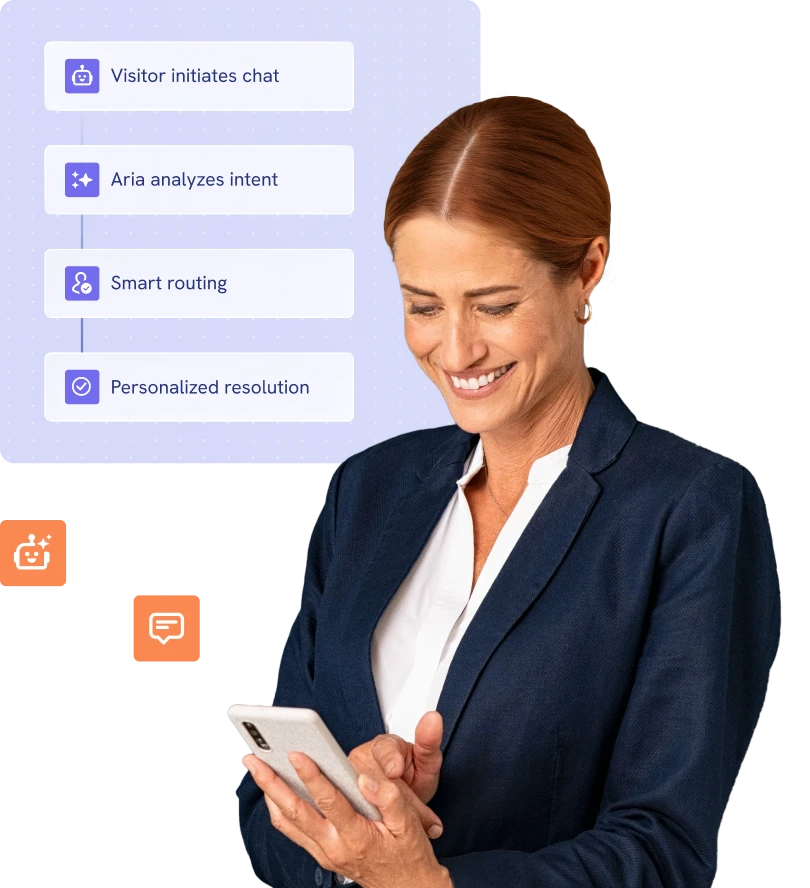
BUSINESS IMPACT
What banks are achieving with conversational AI
The outcomes cluster around three measures: deflection and resolution rate, productivity, and conversion.
bot interactions per year alongside 240,000 agent-handled conversations
FTE-equivalent efficiency gains across all channels through automation
reduction in Average Handling Time – from 8 min 20 sec to 6 min 40 sec
cross-sell rate when Unblu Sidekick is in use, versus 10% in self-service journeys
increase in digital sales conversion using service-to-sale conversational flows
productivity uplift reported by Unblu customers on aggregate
Why the compliance architecture matters
The US Consumer Financial Protection Bureau (CFPB) has warned that conversational AI deployments that trap customers without access to a human agent, or fail to protect customer data, risk breaching consumer-protection law. As banks move from rule-based bots to large language models, that regulatory exposure grows. That is the gap between a generic chatbot and conversational AI built for banking – and the reason compliance-first architecture is not optional in a regulated institution.
CUSTOMER PROOF
Conversational AI reaching production maturity in regulated banks
Two examples that demonstrate what conversational AI looks like in practice – one focused on volume and automation, the other on advisor augmentation and cross-sell.

PostFinance, an Unblu customer since 2016, built a layered conversational model that blends bot automation with human agents across Live Chat, Co-Browsing, and Secure Messenger. The bank handles more than 20,000 Unblu conversations every month, consolidated its entire inbound team into a single inbox – retiring legacy email – and achieves efficiency gains equivalent to approximately 40 full-time staff through automation across all channels. It is the clearest example of conversational AI reaching production maturity in a European retail bank, with bot and human working in one layer rather than as separate channels.

BPER Banca, part of one of Italy’s largest banking groups, deployed Unblu’s Suggestion Support (Bot Sidekick) to 700 advisors, integrated with Salesforce and grounded in the bank’s own approved knowledge documents. Average Handling Time fell 20% – from 8 minutes 20 seconds to 6 minutes 40 seconds. The standout result: a 74% cross-sell rate when advisors use the Sidekick, compared to 10% in self-service journeys. BPER’s hybrid model – AI reach paired with human judgment at the point of decision – is a leading example of generative AI applied to advisory in a controlled, compliant way.
SUPPORTING CAPABILITIES
The products that deliver conversational AI in banking
Conversational AI in banking runs on a connected stack of capabilities organized across the Unblu platform. While the AI-specific features – orchestration, agents, and efficiency tools – sit within Unblu Aria, they serve to improve and enhance Unblu Spark’s channels.

The encrypted, authenticated channels the AI layer operates within, embedded inside the bank's own app or portal. Secure Messenger replaces non-compliant WhatsApp and email for ongoing advisor-client relationships. Live Chat handles real-time support and service-to-sale interactions. Video & Voice delivers browser-based advisory meetings with no app download required. All conversation data stays under the bank's control with full audit trails.
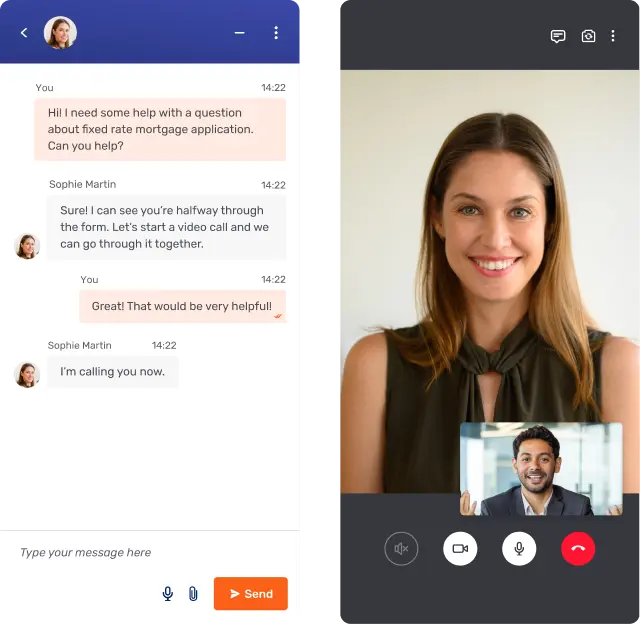

Open-ended queries route to AI via an intent-based bot. Regulated steps follow deterministic, rule-based flows with human-in-the-loop. The bank decides which is which, designing both in a no-code visual Flow Builder. Teams already invested in Microsoft can design those flows through a native Copilot Studio integration.
.webp)
Purpose-built agents available 24/7 across all channels. The Virtual Agent handles intake, triage, and FAQ responses grounded in the bank's own knowledge sources, with real escalation to a human agent when needed. Intelligent routing detects customer intent and sends conversations to the right team after checking agent availability in real time. Sentiment detection monitors tone and escalates with full context when conversations shift.

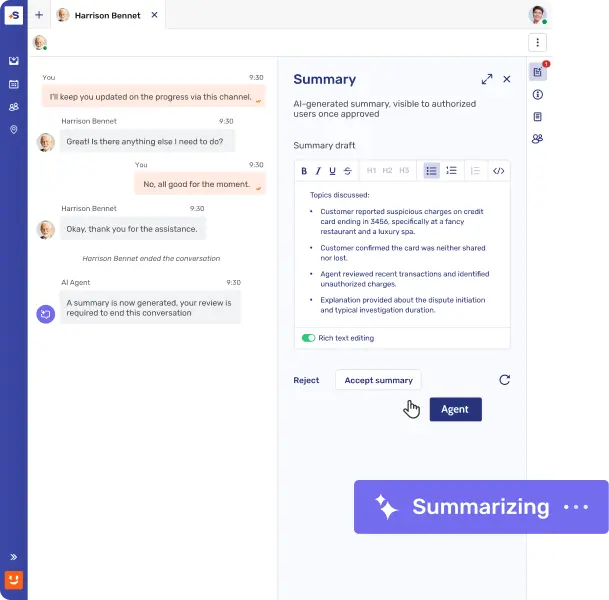
AI tools that reduce handling time and reclaim advisor capacity. Suggestion Support (Bot Sidekick) delivers real-time, customer-invisible answer suggestions and next-best-action prompts inside the advisor workbench, grounded in approved knowledge sources. Summaries and Transcripts automatically condense interactions for documentation and compliance auditing. Captions and Translations provide bidirectional real-time translation across 30+ languages for chat, plus live captioning for video and voice calls.
RELATED Content
Go deeper:
The conversational AI cluster
This hub maps the topic. The linked articles below provide the deeper treatments – each focused on one sub-topic in the conversational AI cluster.
Frequently asked questions
What deployment options does conversational AI offer for banks?

Banks can deploy through Unblu’s cloud (on Google Cloud Platform or Swiss sovereign cloud) or as a fully on-premise installation – giving institutions with strict data-residency requirements complete control over where their data lives. On the AI inference side, Unblu Aria adds a further layer of choice: Unblu-managed Azure infrastructure, where no customer content is used for model training, or a customer-managed option where the bank connects its own LLM keys and infrastructure, including on-premise models. Most generic conversational AI vendors offer cloud only – the three-way platform deployment flexibility combined with dual LLM model options is a hard differentiator for European banks with data-sovereignty requirements.
How does conversational AI impact the security and privacy of banking data?
Conversational AI built for banking gives institutions fine-grained control over what customer data is shared with AI models, including the option to keep the model entirely within the bank’s own infrastructure. Unblu Aria supports customer-managed and on-premise model deployment so data never leaves the bank’s environment, and uses no customer content to train models. Every AI interaction is logged in full audit trails. The platform holds SOC 2 Type II, ISO 27001, ISO 27017, and ISO 27018 certifications, with deployment aligned to GDPR, MiFID II, DORA, and FINMA requirements.
How does conversational AI compare to traditional banking chatbots?
A traditional banking chatbot follows scripted, rule-based decision trees; conversational AI orchestrates large language models with intent detection to understand open-ended questions, maintain context, and route intelligently between automated flows and human agents. In a banking context, the more important difference is governance: conversational AI built for financial services keeps model data under the bank’s control, enforces human-in-the-loop for regulated steps, and logs every interaction for audit – where a generic chatbot bolted onto a website does not. The compliance architecture is what determines whether a feature reaches production in a regulated bank.
How does conversational AI improve customer service in banking?
Conversational AI improves banking customer service by resolving common questions instantly through automation, reducing wait times, and freeing human agents for complex cases. It maintains context across channels so customers do not repeat themselves, supports more than 30 languages through real-time translation, and equips agents with next-best-action suggestions that improve first-contact resolution. Because the AI escalates to a human advisor for anything outside its scope – and for regulated steps – customers get the speed of automation without losing access to a person when it matters.
Why are banks adopting conversational AI?
Banks adopt conversational AI to handle rising conversation volume without proportionally increasing headcount, shorten resolution times, and convert service interactions into sales. The strategic driver is doing this inside the bank’s own secure channels rather than ceding the customer relationship to third-party platforms. For regulated institutions, the deciding factor is whether the technology can deliver these gains while satisfying data-residency, retention, and audit requirements – which is why compliance-first conversational AI, rather than a generic chatbot, is what reaches production in banking.
How is conversational AI used in the banking industry?
Banks use conversational AI in three main ways: customer-service automation, advisor assistance, and service-to-sale conversion. Customer-service automation uses an AI virtual agent to handle intake, triage, and routine questions across Live Chat, Secure Messenger, and voice. Advisor assistance deploys agent-assist tools that deliver real-time answer suggestions, conversation summaries, and multilingual support inside the advisor workspace. Service-to-sale surfaces relevant offers during support interactions, turning service conversations into cross-sell opportunities. Across all three, intent detection routes each conversation to the right automated flow or human agent. The trend toward agentic AI – where AI agents handle multi-step tasks end-to-end rather than just responding to single queries – is accelerating adoption, particularly for onboarding, account servicing, and service-to-sale flows.
See conversational AI in banking in action
Talk to an Unblu specialist about how Aria fits your institution’s compliance requirements, existing systems, and customerengagement goals.
