

.png)
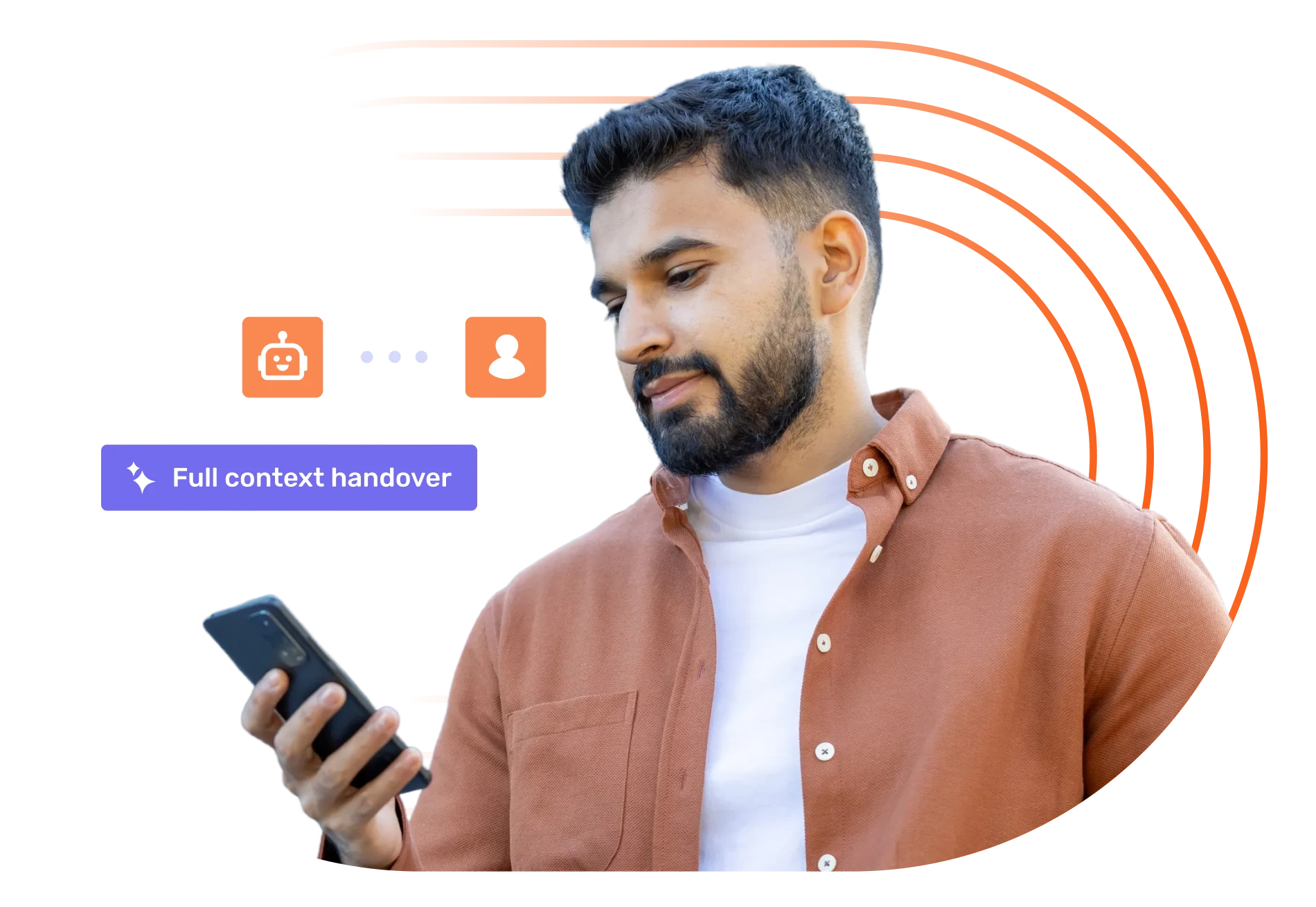

Every one of the ten largest commercial banks in the United States has deployed an AI chatbot as part of its customer service operation, according to the Consumer Financial Protection Bureau, a pattern that holds across financial institutions well beyond the largest ones. Yet on the mobile apps those same customers use every day, only 28% actually turn to the virtual assistant when something goes wrong, per J.D. Power's 2026 U.S. banking mobile app satisfaction study.
That gap between deployment and use is the real story in banking chatbots right now, and it's fundamentally a customer experience problem, not a model one. The technology has been shipped almost everywhere across financial services. Trust has not followed it there. Closing that gap is less about swapping in a better model and more about redesigning what the bot is allowed to do, and how visibly it hands off when it can't.
Banking chatbots have moved from novelty to infrastructure
Ten years ago, conversational AI in banking meant a chatbot pilot project bolted onto a website. Today it's closer to plumbing.
Deployment is now table stakes, not a differentiator. The CFPB's review found that all ten of the largest US commercial banks run an AI chatbot; the Bureau estimated that 37% of the US population, over 98 million people, had interacted with one by 2022, and projected that user base to reach 110.9 million by 2026. Most of that volume is unglamorous. Account balances, transaction history, card disputes, and fraud alerts make up the bulk of it, the kind of high-frequency, low-complexity customer interactions that used to tie up call centre staff. Banks stopped asking whether to build a chatbot years ago. The competitive question moved to what the virtual agent is actually trusted to do.
But usage still lags far behind availability. J.D. Power's 2026 study found that while core digital banking experience remains strong, virtual assistant adoption sits at just 28% of app customers, and the firm frames this as a "high-impact opportunity" precisely because it's still so low. Satisfaction tends to follow capability rather than presence: among the customers who do use a virtual assistant, overall satisfaction runs 18 points higher than among non-users, and JD Power found that satisfaction with the assistant itself climbs steadily as it's perceived to be more comprehensive. Even at a leading European bank actively investing in generative AI, McKinsey found that a classic chatbot resolved only 40 to 45% of the 85,000 weekly customer chats it handled, leaving more than 16,500 customers a week needing a human anyway. The ceiling on what a bot resolves alone has been lower than the marketing suggests for a long time.
The trust gap is where banking chatbots actually fail
The gap isn't abstract. It shows up as a specific, recurring complaint about customer service, and increasingly as a regulatory one.
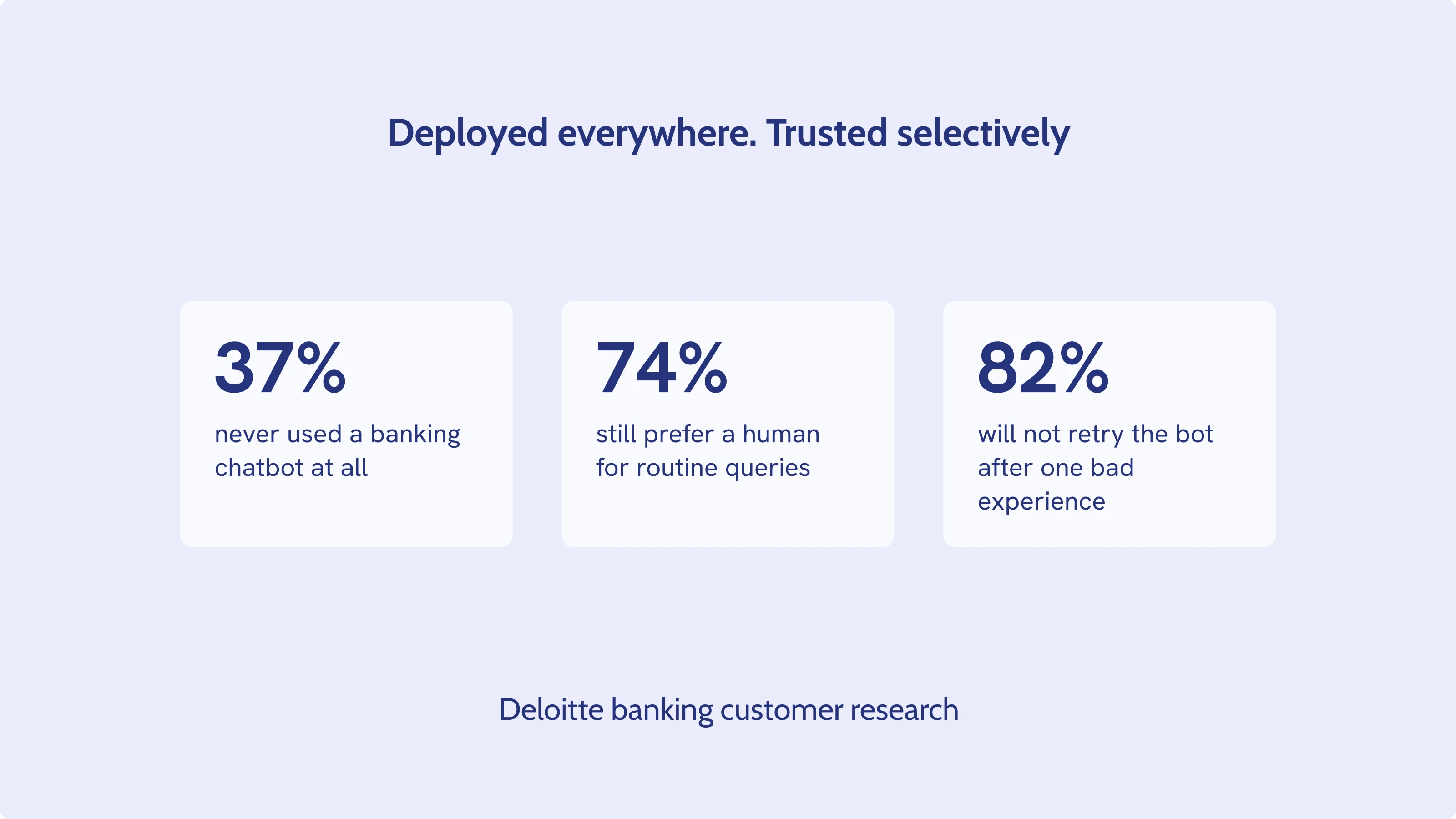
Rigid flows create the "can't I just talk to someone" moment. Deloitte's research found that 37% of banking customers surveyed had never interacted with an AI chatbot at all, and among those who had, 74% still preferred a human agent for simple, routine queries. Of customers who'd used a chatbot for a product inquiry and had a bad experience, 82% said they wouldn't try the bot again for that purpose, and nearly half said they'd rather visit a branch. Deloitte's own framing is blunt: banks that keep treating chatbots as pure cost-cutting tools, rather than as a designed part of customer engagement, are the ones stuck with these numbers.
Regulators are already watching the failure modes. The CFPB's issue spotlight on chatbots documented what it called "doom loops": customers stuck in repetitive, scripted responses with no offramp to a human, particularly around disputes the bot isn't built to recognise. The Bureau warned that this isn't just a service problem but a compliance one, since federal consumer financial law obligates institutions to give customers straight, accurate answers regardless of which channel delivers them. Regulatory compliance for AI chatbots is converging on the same failure point from a different angle too. Legal analysis from Mayer Brown notes that organisations deploying AI systems that interact with customers increasingly need to disclose plainly that the customer is talking to AI, not a person, and under the EU AI Act, high-risk AI systems in the financial sector must meet specific compliance requirements by 2 August 2026, a deadline now weeks away. None of this replaces the baseline security expectations customers already assume are in place: multi-factor authentication before account details are disclosed, encryption in transit and at rest, and compliance with data privacy regulations like GDPR. It sits on top of them.
Closing the gap means designing for escalation, not deflection
None of this is an argument against chatbots, or for turning every one of them into a fully autonomous AI agent built on agentic AI. Artificial intelligence in financial services works best when it's designed for what it's actually good at, not deployed everywhere at once. It's an argument against building them backwards.
Route by complexity, not by channel. The instinct in most first-generation deployments was to push every inbound query through the bot and see what stuck. A more durable design starts by classifying intent before deciding whether the query needs an LLM at all. Deterministic, rule-based logic handles regulated, high-stakes steps precisely because it's auditable; an LLM-driven layer handles open-ended requests where flexibility matters more than predictability. That routing logic increasingly lives in a no-code flow builder, so a compliance or product team can adjust it directly rather than filing a ticket with engineering, and for banks operating across borders it has to work in every language customers actually use, not just the one the head office speaks. That hybrid split, rather than a single model trying to do both, is what keeps a bot fast on simple requests without gambling on the complex ones.
Make the handoff invisible to the customer, not just possible for the agent. McKinsey's research on AI in bank customer care makes a sharp point about why containment-rate obsession backfires in financial services: a bot might hit a 90% containment rate on disputes, but if the underlying issue wasn't actually resolved and the customer calls back three days later, the total cost per contact goes up, not down. A clean handoff means the human agent inherits the full conversation, along with whatever account and transaction history already lives in the bank's CRM or core banking system, not a customer who has to explain the problem from scratch to a second system.
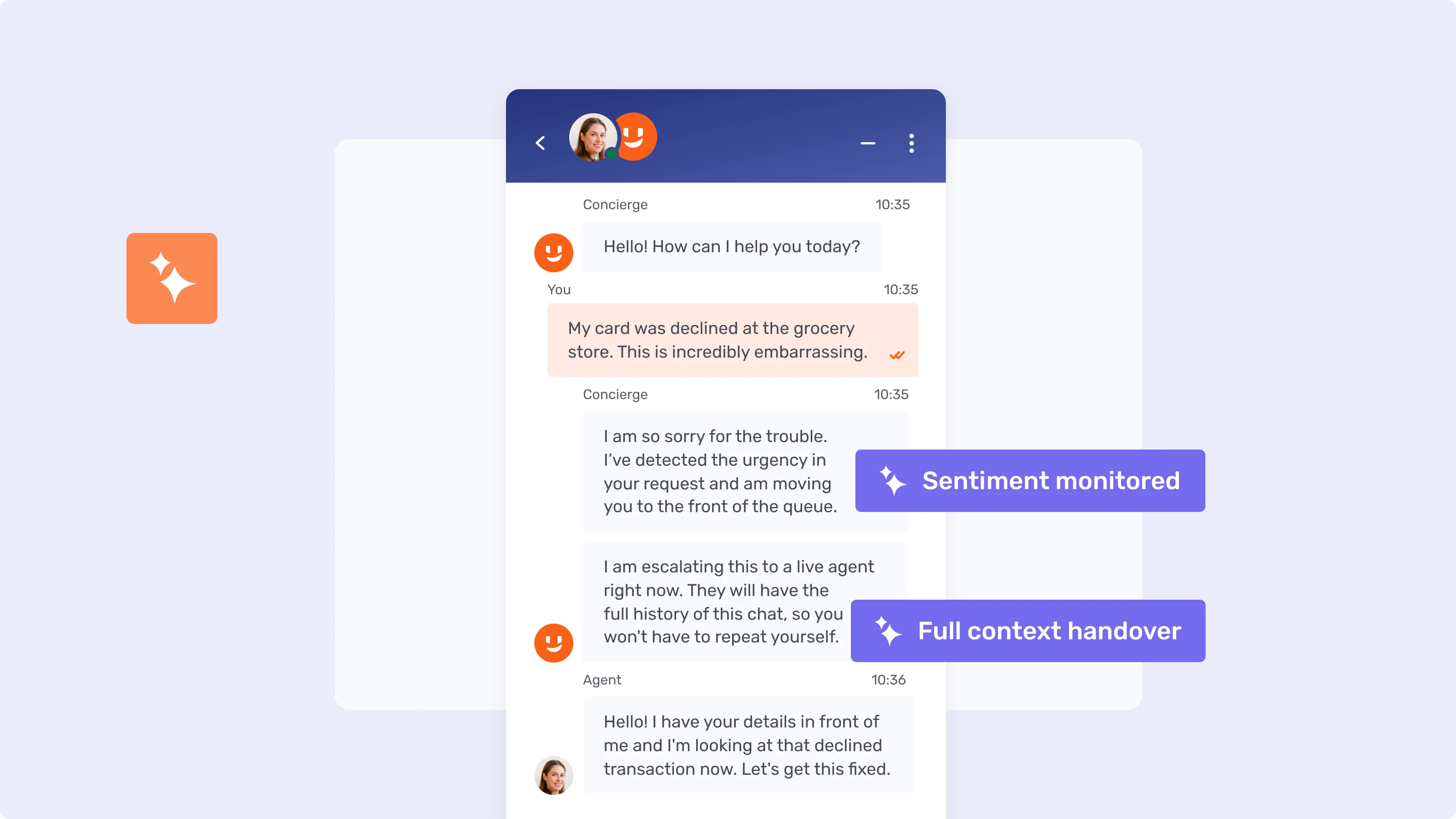
Keep humans in the loop for regulated moments by design, not by exception. McKinsey is explicit that AI in banking operates under constraints most industries don't face, including fair lending, explainability, and data residency, and that too many AI projects only reach risk and legal teams once they're already being scaled. The regulatory rulebook hasn't caught up either. When the OCC, Federal Reserve, and FDIC issued revised interagency Model Risk Management guidance in April 2026, they explicitly excluded generative and agentic AI models from its formal scope, while still stating that a bank's own risk management and governance practices should determine appropriate oversight for those excluded tools. Formal rules haven't caught up to gen AI chatbots, but general governance expectations already have, which is exactly the case for building the audit trail and human-in-the-loop checkpoint into the architecture from day one, rather than waiting for a rule that hasn't been written yet.
Some banks are already closing it
PostFinance keeps its bot and its agents in the same inbox, not in competing systems. PostFinance handled roughly 1 million bot interactions alongside 240,000 agent-managed conversations in 2023, after consolidating its entire inbound team, including what used to be a separate legacy email channel, into a single inbox. The bot volume and the human volume were never designed as competitors for the same queries; they were designed as tiers of the same system.
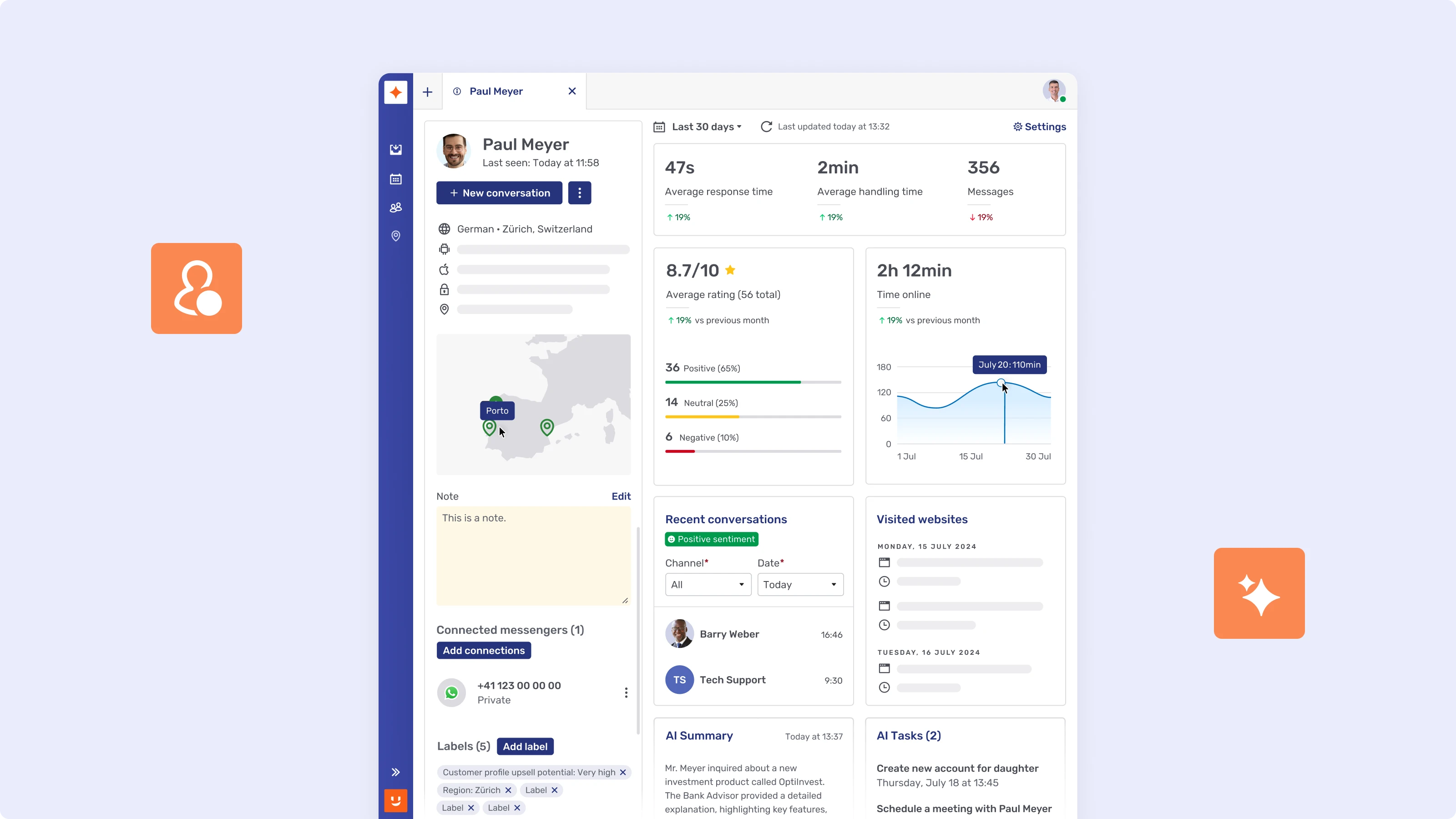
BPER Banca put the AI behind the advisor, not in front of the customer. Rather than pointing a customer-facing bot at its retail customers, BPER Banca equipped 700 advisors with Unblu's Suggestion Support, an AI layer that draws on the bank's own approved knowledge base to surface real-time answer suggestions inside the advisor's workspace, invisible to the customer, which the advisor can accept, edit, or dismiss. Paired with Live Chat, that combination cut average handling time 20%. It's a reminder that "banking chatbot" doesn't have to mean customer-facing at all; sometimes the highest-trust place to put the AI is behind the human, not instead of them.
Swiss Post grew its bot's service rate by iterating, not by launching perfect. Swiss Post's chatbot now handles 200,000-plus customer support inquiries a month across chat, WhatsApp, and live agents, and its bot service rate climbed to 72% within roughly 18 months, up from 55% at launch. That trajectory matters more than the endpoint: the bot didn't launch trusted, it earned trust incrementally as the team tuned what it was allowed to handle.
The bots that earn trust are the ones designed to lose gracefully
The banks closing the adoption gap aren't the ones with the most sophisticated model. They're the ones that stopped measuring customer support purely on how much human contact the bot avoided, and started measuring it on how well it behaved in the moment it couldn't help. Swiss Post's climb from 55% to 72% service rate, PostFinance's single inbox, and BPER's advisor-facing model are different shapes of the same decision: route by complexity, keep the compliance trail intact, and make sure the handoff never feels like starting over.
Unblu Aria's Intent-Based Bot applies exactly this hybrid logic to conversational AI, using deterministic flows for regulated steps and an LLM Orchestrator for open-ended requests, natively connected to Unblu Workbench so escalation carries full context, and it's available across cloud, Swiss sovereign cloud, and on-premise deployment options with a choice of Unblu-managed or customer-managed LLMs.