

.png)


Most advice on average handle time is about making agents faster: better scripts, more training, tighter call control.
This approach seems intuitive, but it rarely moves the needle in any kind of meaningful way. Why is this?
To put it simply, it’s because it targets the parts of a call that are already efficient and ignores the parts where time actually disappears, the seconds an agent spends searching for an answer, describing a screen, or finishing paperwork after the customer has hung up.
Banks that get AI-driven contact center transformation right are seeing a 10 to 20 percent reduction in average handling time, according to McKinsey's April 2026 analysis of AI in banking customer care. The gains come from a different move than the usual playbook: instead of pushing agents to work faster, put support inside the interaction so the moments where they get stuck stop happening.
There are four of those moments, and this post takes them one at a time: the mid-call knowledge search, the screen an agent has to describe instead of show, the after-call work nobody budgets for, and the compliance line that decides whether a reduction is real or just a lower number. The last one is the one most guides skip, and in a regulated bank it's the one that matters most: not every second you shave off a call is a second you're allowed to shave off.

Why does real-time assist cut more time than training ever did?
Training tells an agent what to do next time. It does nothing for the call handling happening right now, when the agent is toggling between systems trying to find an answer while the customer waits, or searching a knowledge base that's technically there but too slow to use mid-conversation.
Agents lose the most time searching, not talking. The slowest part of a complex banking call is rarely the conversation itself; it's the pause while the agent looks something up, switches screens, or double-checks a policy before answering. Self-service now absorbs the simple, scriptable contacts, which means the calls that reach a human agent are the complicated ones where that search time is longest, exactly the calls where a better manual or a tighter script does the least good.
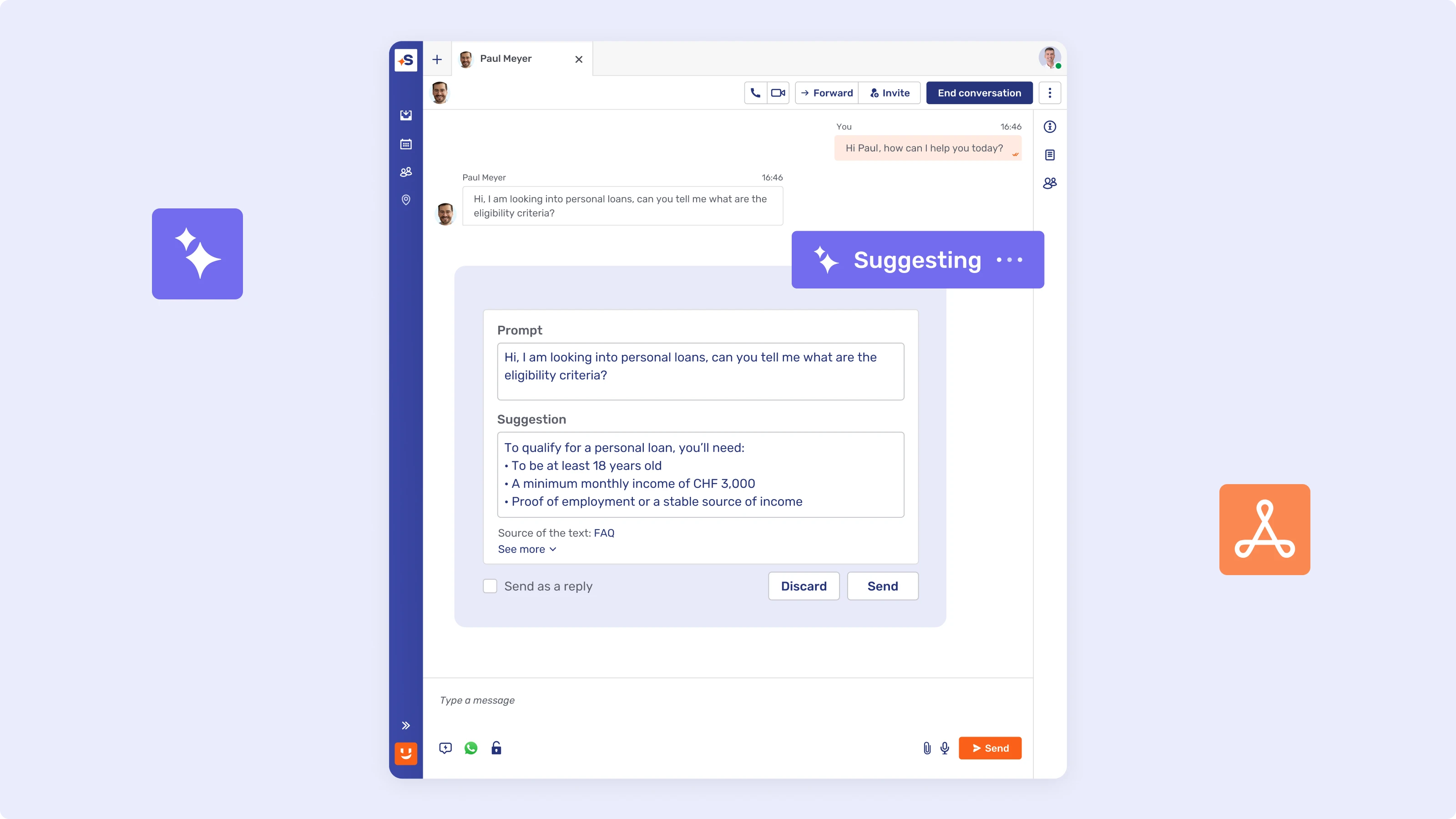
BPER Banca's AHT fell 20% once assist moved into the call itself. BPER equipped 700 advisors with Unblu's Bot Sidekick, integrated with Salesforce and grounded in the bank's own knowledge base of approved documents. Average handle time dropped from 8 minutes 20 seconds to 6 minutes 40 seconds. The mechanism is simple: the next-best-action prompt appears in the same window the advisor is already working in, so there's no second screen to check and no hold while someone searches for an answer. Read the BPER Banca case study.
Showing a screen beats describing it
A large share of banking calls are not information problems. They're navigation problems: a customer needs to be walked through a form, a portal, or a setting, and describing where to click takes longer, and adds to call length, than showing it would.
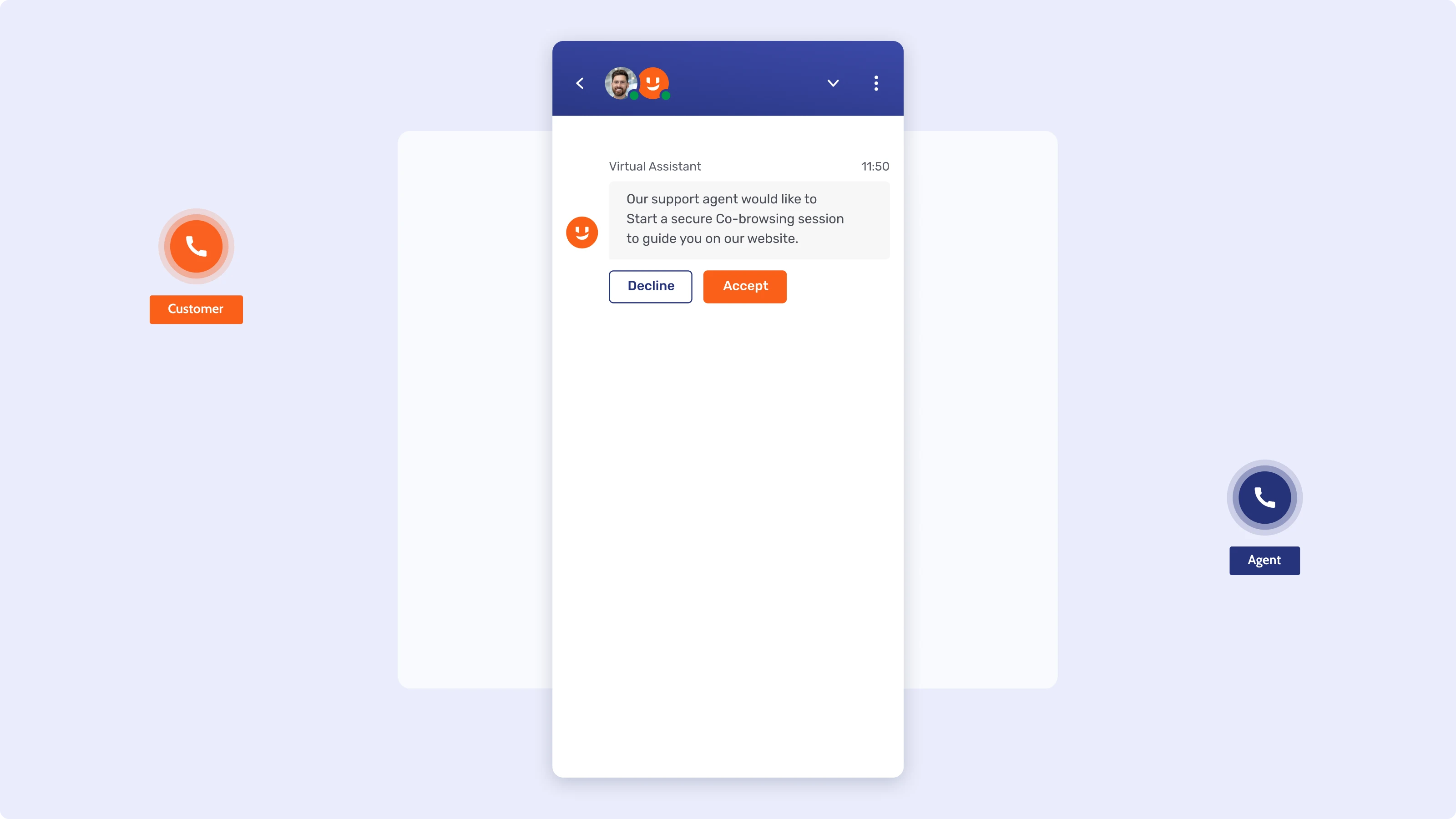
Explaining a screen takes longer than showing it. Embedded Co-Browsing lets an agent see and guide a customer through the exact same interface in real time, with sensitive fields like passwords and card numbers automatically masked. There's no "click the third tab, then the button underneath" back-and-forth, because both people are looking at the same thing.
Three banks, three different kinds of pressure, the same result. Crédit Agricole next bank used Embedded Co-Browsing to guide more than 60,000 clients through a new e-banking platform during a migration that multiplied support call volume tenfold, and still contained AHT to 18 minutes against a 30-minute projection. Banca Dello Stato holds Co-Browsing-assisted calls to a 10-minute average AHT while absorbing a 15% rise in support requests without adding headcount. A major French corporate bank running Embedded Co-Browsing on its SME portal reports a 7-minute AHT on assisted calls, a fraction of what a talked-through equivalent takes.
Where the other half of handle time actually goes
Most conversations about AHT stop at the moment the call ends. That's a mistake, because the clock doesn't. AHT breaks into three pieces: talk time, hold time, and after-call work, sometimes called wrap time, and the last one is the piece most banks don't budget for.
After-call work is the part of call handling time nobody budgets for. Deloitte's Netherlands practice built an automatic call-logging tool for large financial institutions in insurance, pensions, and mortgages that summarizes a call within 10 seconds of it ending, rolled out to more than 2,000 end-users. Deloitte's stated rationale is that manual logging both varies the quality of legally required call summaries and adds cost, meaning after-call work isn't just a productivity drag; in a regulated bank it's a documentation problem too.
PostFinance has held AHT flat for seven years by automating the paperwork, not the conversation. PostFinance blends its text and voice channels so that agent time isn't lost reconciling separate systems after a handoff, and estimates automation-driven efficiency gains equivalent to roughly 40 full-time staff across all channels. The AHT number never had to move, because the invisible half of it did.
Is every AHT reduction actually safe in a regulated bank?
This is the question the generic playbook skips, and it's the one that separates a real efficiency gain from a liability with a lower number attached.
Cutting a corner a regulator will flag is not efficiency. The Consumer Financial Protection Bureau has warned that financial institutions risk violating federal consumer protection law when chatbot or AI deployments hinder a customer's ability to reach a human agent, particularly when inaccurate information or blocked escalation causes real harm. An AHT reduction built on deflecting customers away from a human, rather than assisting the human faster, is exactly the shortcut the CFPB is describing.
Customers want the AI, but they want the exit door too. 87% of customers say it's essential for companies to provide an option to reach a human agent when using GenAI for customer service, according to a Gartner survey of more than 3,500 customers published this month. Gartner's advice to service leaders is direct: don't make GenAI a mandatory first step for every issue, because forcing customers through failed AI interactions before they reach a person is what erodes trust in the tool. Every capability described here runs on the same certified security posture, SOC 2 Type 2 and ISO 27001, across every channel, so the audit trail doesn't depend on which tool the customer happened to reach first.
The AHT number that matters is the one that survives a compliance review
None of the four levers above work by removing a step a customer needed. They work by moving support to the point where the agent was actually stuck: mid-search, mid-explanation, mid-paperwork. That's a more durable kind of efficiency, and it's the only kind that holds up once volume spikes, once a regulator asks how a number was achieved, or once a customer who got deflected files a complaint.
The pattern across BPER Banca, Crédit Agricole next bank, Banca Dello Stato, and PostFinance isn't a single tool. It's the same discipline applied to four different points in the call: assist, guidance, documentation, and escalation, all inside one audit trail rather than four separate systems.