

.png)


What wealth management leaders need to fix before $83.5 trillion in assets changes hands
By 2048, an estimated $83.5 trillion in wealth is projected to shift to Gen X, Millennial, and Gen Z heirs, according to Capgemini's World Wealth Report 2025, part of a broader generational transfer that Cerulli Associates projects could reach $124 trillion in total across the same period. Capgemini found that 81% of next-gen inheritors plan to leave their parents' wealth management firm within one to two years of receiving that inheritance. The reason cited most often isn't fees or performance. It's digital: 46% point specifically to a lack of services on their preferred channels.
Most private banks have already responded to that pressure by investing heavily in the client-facing app. What's lagged behind, and what's now starting to show up in the numbers, is the advisor's own toolkit.
Why advisor tools have become a retention risk, not just a productivity one
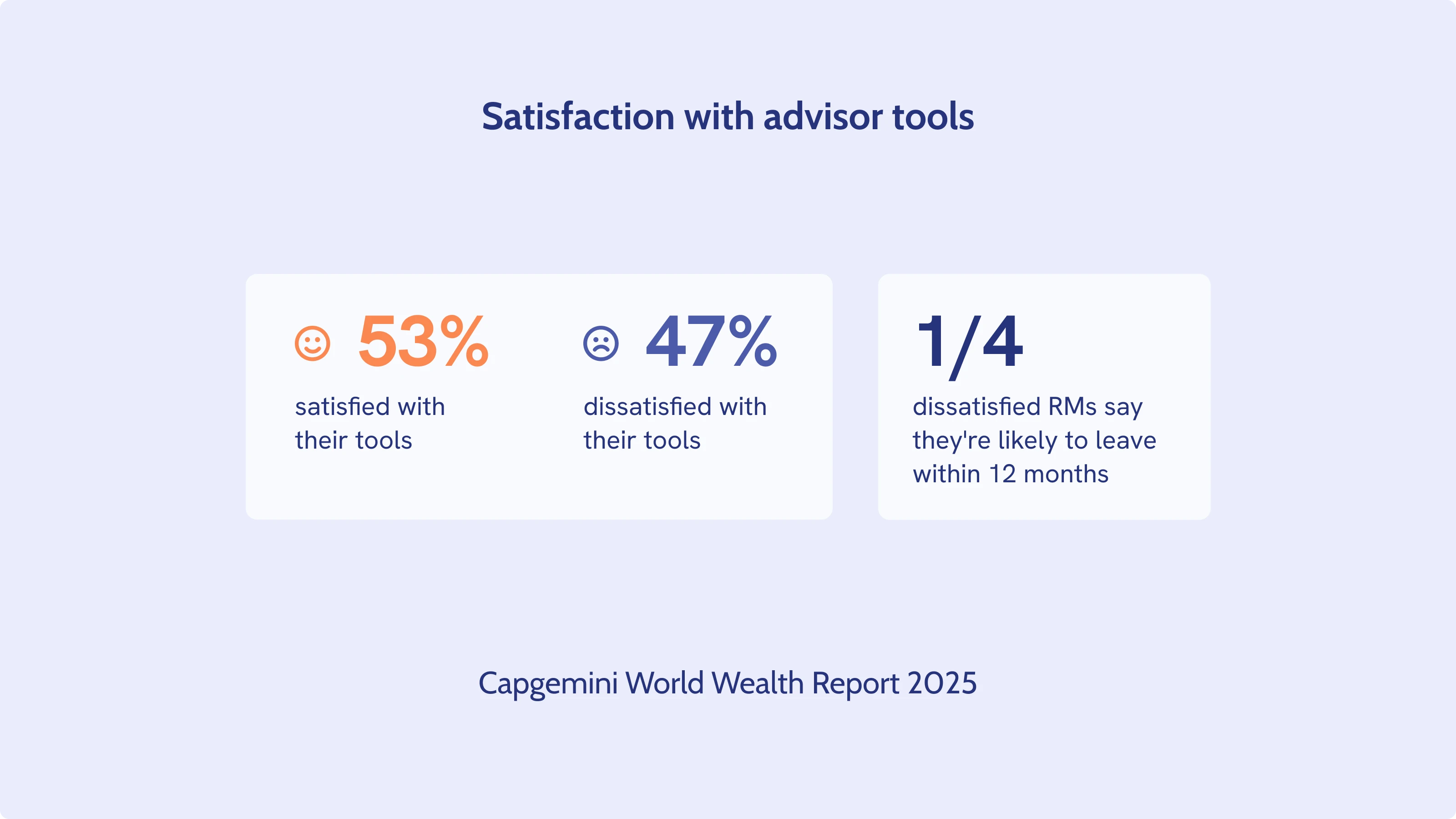
Capgemini found that 47% of relationship managers are dissatisfied with the tools their firm gives them to do their job. Among those dissatisfied RMs, one in four say they're likely to leave within twelve months. That statistic matters well beyond HR, because when a relationship manager leaves a private bank, the client relationship and the assets under management frequently leave with them: 62% of next-gen high-net-worth individuals say they would follow their advisor to a new firm.
JD Power's 2025 US Wealth Management Digital Experience Study, based on more than 5,600 advised and self-directed investors, found that a consistent experience across digital and human channels is critical to satisfaction. Advised clients with access to well-integrated digital tools, such as virtual assistants, scored 72 points higher on JD Power's 1,000-point satisfaction scale than clients without them. This isn't a UX complaint. It's a pipeline risk sitting inside the technology roadmap, and closing it comes down to five things: how advisors set expectations, what replaces the consumer chat habit, where advisors actually do their work, what advisors carry with them day to day, and whether the systems already in place actually join up.
Set expectations without going dark
Persistent messaging can feel, at first glance, like an always-on obligation. In reality, clients have usually been emailing and calling advisors outside business hours for years; messaging doesn't create that expectation, it just makes it visible. What advisors need instead is a way to set that expectation on their own terms. A status and status message, such as in a client meeting until 3 p.m., back Monday, or reply within 24 hours, lets the advisor control the relationship on their own terms, the same way any professional messaging tool allows a person to signal availability without going dark. Deputy and assistant management keeps a client's request moving when the primary advisor is unavailable, and breakout conversations bring in a specialist, compliance officer, or team member without the client repeating themselves or switching channels. None of this asks an advisor to be reachable at midnight. It asks the platform to make coverage visible instead of invisible.
Replace WhatsApp without losing the ease clients love
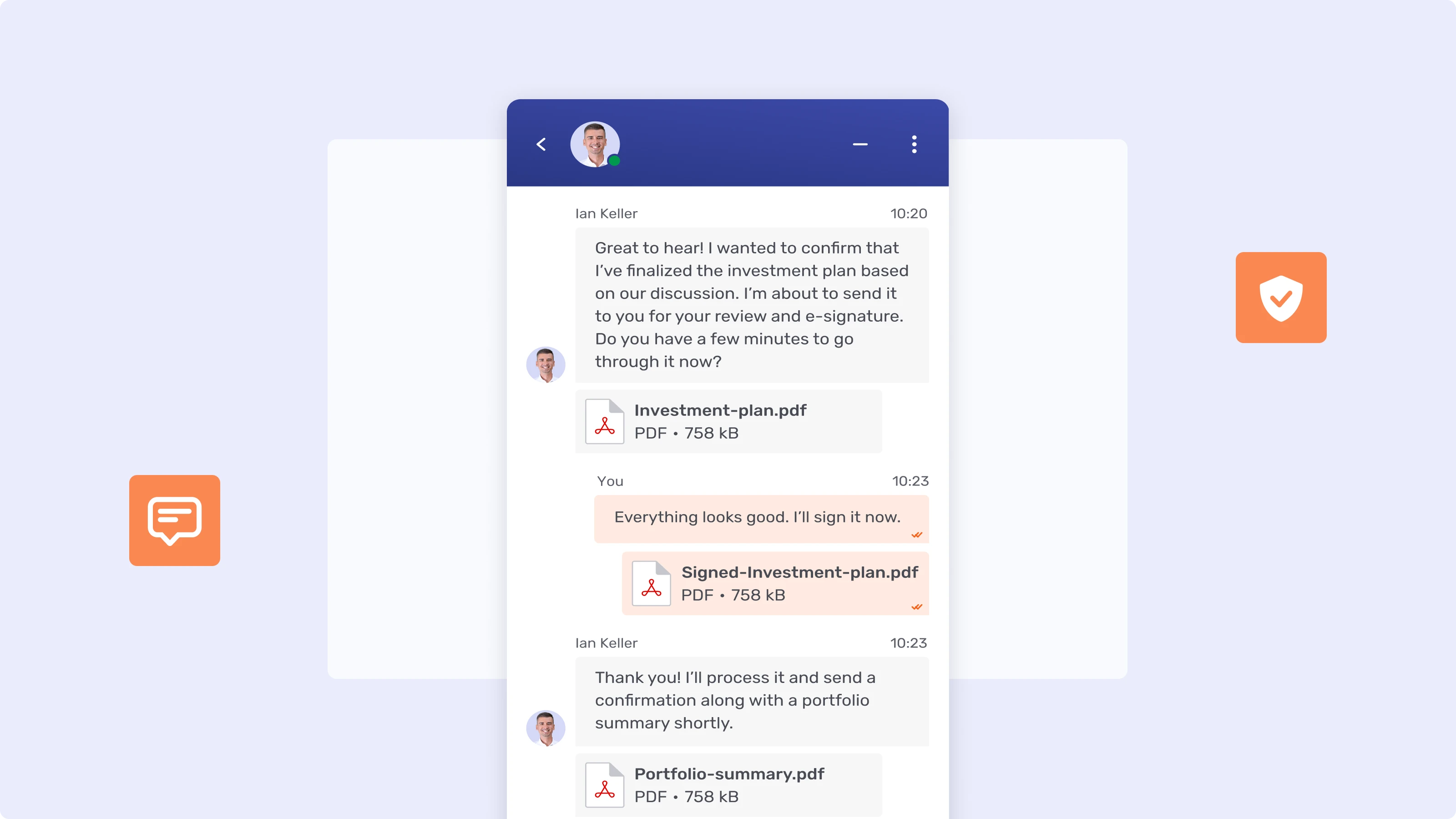
Most advisors are already messaging clients on WhatsApp, and not because anyone approved it, because it's fast, familiar, and requires no explanation on the client's end. The problem was never convenience. It's that every one of those conversations sits on a personal device, outside firm oversight, unrecorded and unsupervised. This isn't a hypothetical exposure: in February 2024, the SEC fined 16 broker-dealers and investment advisers a combined $81 million-plus, with individual penalties reaching $16 million, for failing to preserve employee communications sent through personal channels such as WhatsApp. Under MiFID II, FINRA, and GDPR, that's a supervision gap, an e-discovery risk, and a data residency exposure that sits with the firm, not the advisor. As Olivier Pages, Chief Innovation Officer at CMB Monaco, put it: Forbidding WhatsApp is mission impossible. The alternative isn't banning the habit, it's matching it: giving advisors the same ease of chat through Secure Messenger, with every message captured, archived, and supervisable, and a single client view instead of conversations scattered across personal phones. CMB Monaco has since reached 60% adoption of its secure channel alongside a 25-35% improvement in onboarding efficiency.
Join up the tools advisors already have, instead of adding another one
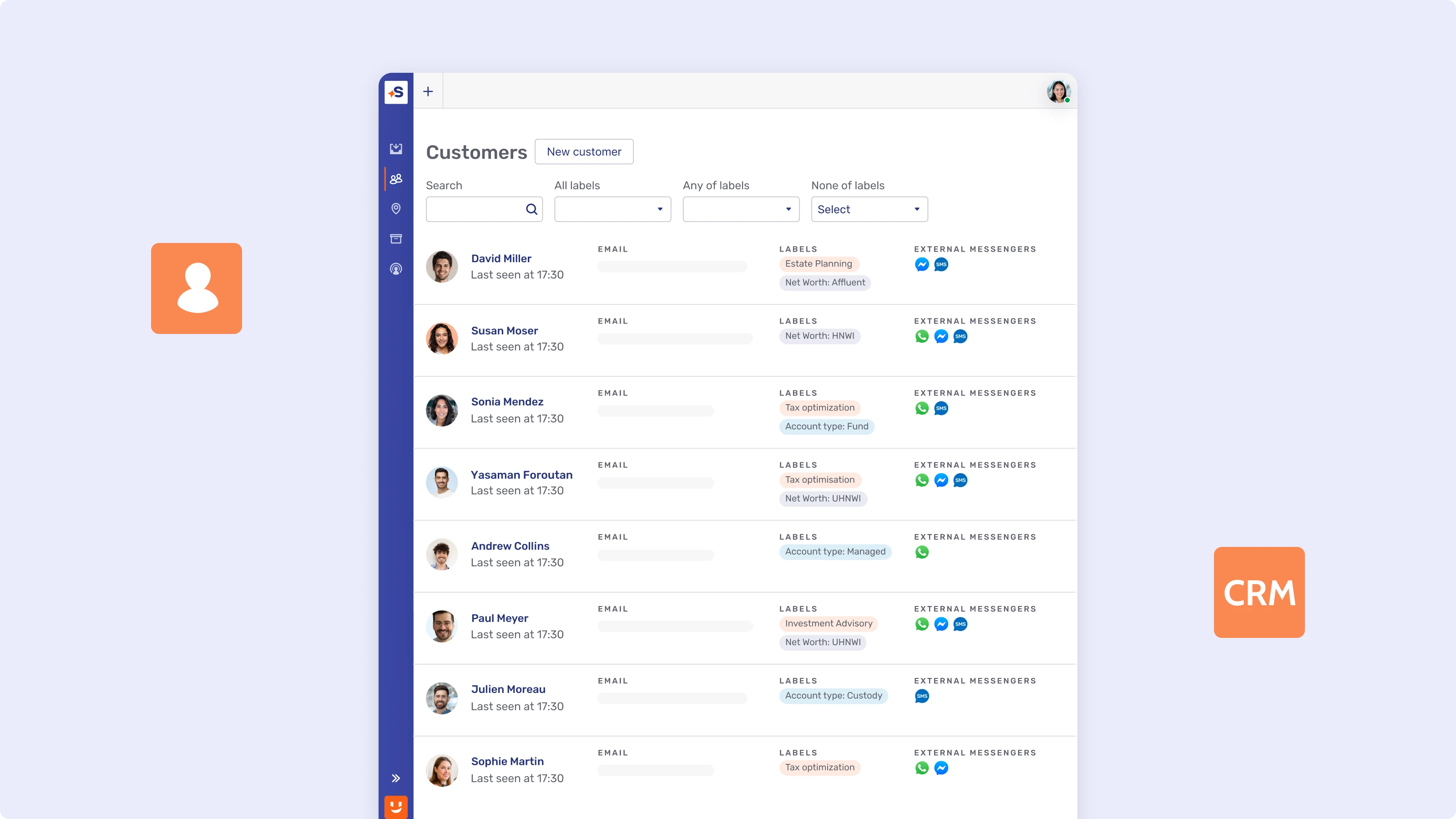
None of the previous points matter if using them means leaving the CRM or RM workbench that already holds the client relationship. Advisors who have to open a separate application, log in again, and rebuild context they'd already built elsewhere will quietly avoid the new tool, no matter how good it is. Unblu's new Agent JS API is built to close that gap, letting messaging, video, and co-browsing be embedded directly into the systems advisors already work in rather than requiring a separate destination. At BPER Banca, for instance, 700 advisors trigger Unblu directly from Salesforce, working from a single interface instead of two.
That same embedding needs to reach every team that needs it, not just the ones an earlier rollout happened to cover. Most large banks already have a call center platform, a CRM, a co-browsing tool, and some form of secure messaging deployed somewhere in the organization. The claim that we already have this is often technically true and strategically misleading at the same time, for two reasons. First, these tools were bought separately, by different teams, at different times, and were never designed to join up: the call center's messaging tool doesn't share a client view with the CRM, and co-browsing doesn't carry conversation history into the next channel. Second, and more specifically at large banks, the call center platform that owns messaging for retail customer service was very often never extended to Wealth and Private Banking. The advisors managing the highest-value, longest-term relationships are frequently the group left out of the rollout entirely, because the platform was scoped for contact center volume, not advisor-client depth.
Closing that gap doesn't require replacing every existing system. Unblu integrates directly into the contact center platforms many banks already run, including Genesys and Microsoft Dynamics, as well as the core banking and CRM layer, through certified integrations spanning Avaloq, Backbase, Temenos, Broadridge, Pershing, Salesforce, Objectway, ti&m, and finnova. That means the same engagement layer that started in the contact center can extend into wealth and private banking instead of stopping at its original scope, which is how one global private bank now runs Secure Messenger across 300-plus relationship managers in 8 countries, with a 40% reduction in RM and back-office workload.
Give advisors a secure, branded tool of their own
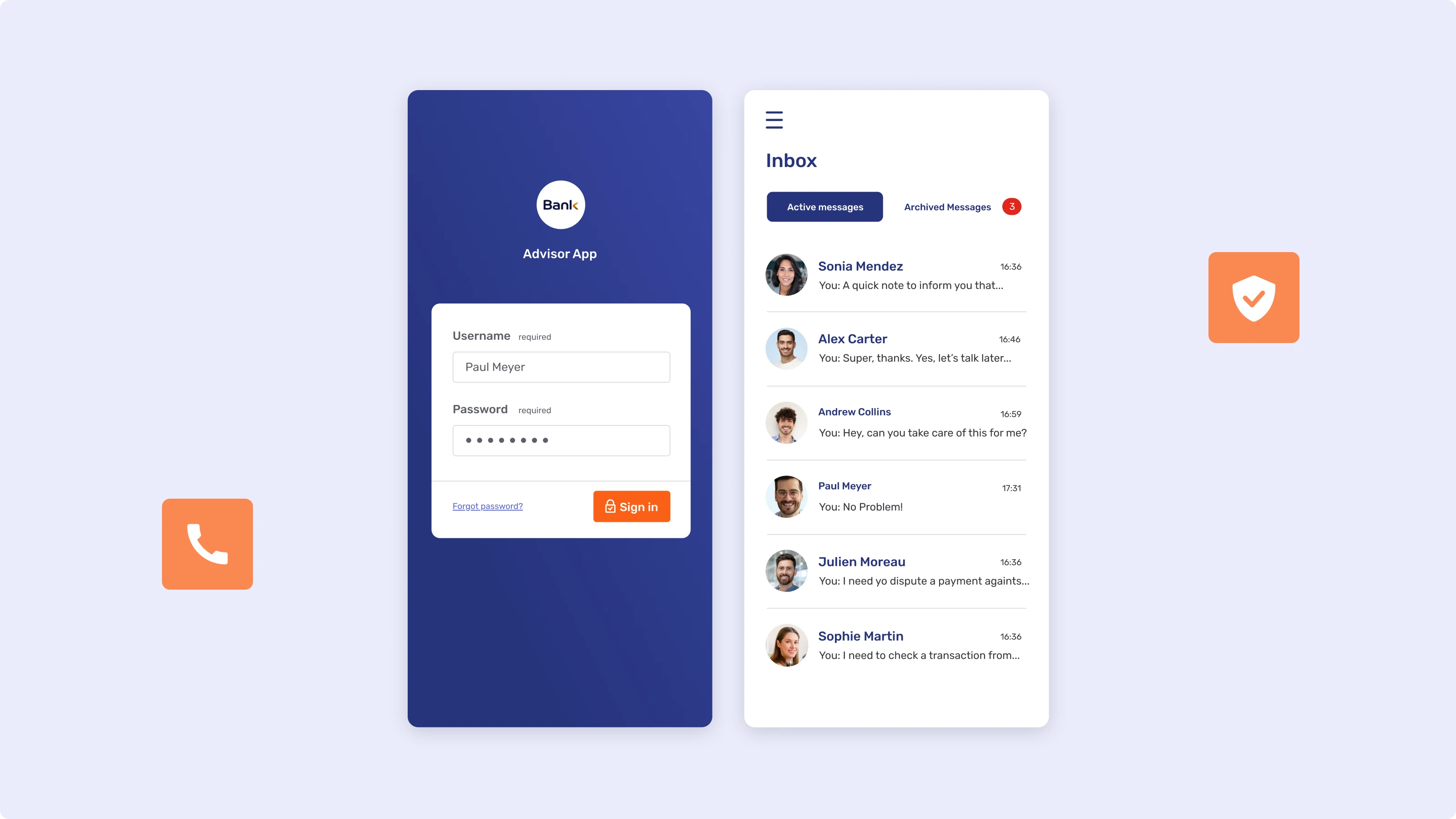
This is where the retention numbers above become solvable rather than just alarming. Many institutions have a dedicated client app, but not a dedicated, secure tool for advisors to respond to clients on the go, and meeting the security bar for one usually means licensing an expensive third-party SDK or funding a custom build. JD Power's 2025 US Financial Advisor Satisfaction Study found that only 20% of advisors under 40 describe their firm as brand conscious, compared to 35% of advisors aged 40 to 64, a gap that tends to show up exactly where advisors are handed a mix of personal apps and email instead of a tool the firm actually built and branded for them. The Brandable Advisor App is a white-label iOS and Android application published under the institution's own brand, giving advisors mobile access to Secure Messenger, Live Chat, Video & Voice, Co-Apping, and Document Collaboration. It ships with a built-in integrity module aligned to the OWASP Mobile Application Security Verification Standard (MASVS), covering app integrity checks, rooting and jailbreak detection, emulator detection, screen capture blocking, and device binding, alongside two-factor authentication, biometric sign-in, and single sign-on through Microsoft or OpenID Connect.
What this means for the roadmap ahead
The firms that treat advisor tooling as a retention lever, not just an efficiency project, are the ones best positioned for the wealth transfer already underway. Across more than 170 banking and financial services implementations and 10,000 advisors worldwide, the pattern holds: when the advisor experience matches the client experience, the relationship survives the handover between generations. When it doesn't, the assets tend to follow the advisor out the door.